Table of Contents
1. Introduction
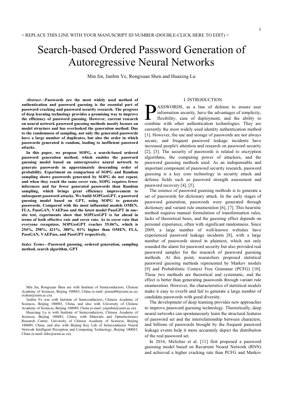
Passwords remain the most ubiquitous method of user authentication. Consequently, password guessing is a critical component of cybersecurity research, underpinning both offensive security testing (cracking) and defensive strength assessment. Traditional methods, from rule-based enumeration to statistical models like Markov chains and PCFG, have inherent limitations in efficiency and diversity. The advent of deep learning, particularly autoregressive neural networks, promised a paradigm shift. However, a critical bottleneck persisted: the standard random sampling generation method. This leads to duplicate passwords and, more detrimentally, a random order of generation, forcing attackers to sift through vast, inefficient lists. This paper introduces SOPG (Search-Based Ordered Password Generation), a novel method designed to make autoregressive password guessing models generate passwords in approximately descending order of probability, thereby dramatically increasing attack efficiency.
2. Background & Related Work
2.1 Evolution of Password Guessing
Password guessing has evolved through distinct phases. Early methods relied on dictionary attacks and manually crafted mangling rules (e.g., John the Ripper), which were heuristic and experience-dependent. The proliferation of large-scale password leaks (e.g., RockYou in 2009) enabled data-driven, statistical approaches. The Markov model (Weir et al., 2009) and Probabilistic Context-Free Grammar (PCFG) (Ma et al., 2014) provided a more systematic, probability-based framework for generation, though they risked overfitting and lacked the capacity to model complex, long-range dependencies in password structures.
2.2 Neural Network Approaches
Deep learning models, particularly Generative Adversarial Networks (GANs) like PassGAN (Hitaj et al., 2017) and autoregressive models like those based on LSTM or GPT architectures, learn the probability distribution of passwords directly from data. They can generate highly diverse and realistic passwords. However, they typically use random sampling (e.g., multinomial sampling) from the learned distribution at each generation step. This fundamental process is agnostic to the global ranking of complete password probabilities, leading to the inefficiencies SOPG aims to solve.
Coverage Rate Improvement
35.06%
SOPGesGPT's achieved coverage rate, significantly outperforming predecessors.
Efficiency Gain vs. Random Sampling
Far Fewer
Passwords and inferences needed by SOPG to reach the same coverage.
Duplicate Rate
0%
SOPG guarantees no duplicate password generation.
3. The SOPG Method
3.1 Core Concept
SOPG re-frames password generation from a stochastic sampling problem into a guided search problem. Instead of randomly picking the next character, it employs a search algorithm (likely a variant of beam search or best-first search) to explore the space of possible password continuations, prioritizing paths that lead to complete passwords with higher estimated probabilities. The goal is to output the password list in an order that closely approximates a true descending sort by $P(password|model)$.
3.2 Search Algorithm
While the PDF abstract does not detail the specific algorithm, the described behavior suggests a method that maintains a priority queue of candidate password prefixes. At each step, it expands the most promising prefix (highest cumulative probability) by querying the neural network for the next character distribution, generating new candidates. By systematically exploring high-probability regions of the password space first, it ensures early generation of the most likely passwords and inherently avoids duplicates.
3.3 SOPGesGPT Model
The authors implement their method on a GPT-based architecture, creating SOPGesGPT. The GPT model (e.g., a decoder-only transformer) is trained on leaked password datasets to predict the next character in a sequence. SOPG is then applied as the generation/inference method atop this trained model, replacing standard sampling.
4. Technical Details & Mathematical Formulation
An autoregressive model defines the probability of a password $\mathbf{x} = (x_1, x_2, ..., x_T)$ as the product of conditional probabilities: $$P(\mathbf{x}) = \prod_{t=1}^{T} P(x_t | x_1, ..., x_{t-1})$$ where $x_t$ is the character at position $t$, and $T$ is the password length. Standard sampling selects $x_t \sim P(\cdot | x_1, ..., x_{t-1})$.
SOPG, conceptually, aims to find and output sequences $\mathbf{x}$ in order of decreasing $P(\mathbf{x})$. This can be viewed as a shortest path search problem in a tree where nodes are prefixes, edge costs are related to $-\log P(x_t | prefix)$, and the goal is to enumerate paths (passwords) in order of increasing total cost (i.e., decreasing probability). Algorithms like Uniform Cost Search (UCS) or its bounded variant, Beam Search with a large beam width and dynamic pruning, can achieve this approximate ordering. The key is that the search's frontier is prioritized by the current path's probability score.
5. Experimental Results & Analysis
5.1 Comparison with Random Sampling
The paper presents compelling results comparing SOPG with standard random sampling on the same underlying model. Key findings:
- Zero Duplicates: SOPG generates a unique list, while random sampling produces many repeats, wasting computational effort.
- Superior Attack Efficiency: To achieve the same cover rate (percentage of passwords in a test set cracked), SOPG requires far fewer model inferences and generates a much smaller total list. This translates directly to faster password cracking in real-world scenarios.
5.2 Benchmark Against State-of-the-Art
SOPGesGPT was benchmarked against major password guessing models: OMEN (Markov), FLA, PassGAN (GAN), VAEPass (VAE), and the contemporary PassGPT. In a one-site test:
- Cover Rate: SOPGesGPT achieved 35.06%, surpassing OMEN by 254%, FLA by 298%, PassGAN by 421%, VAEPass by 380%, and PassGPT by 81%.
- Effective Rate: The paper also claims leadership in "effective rate," likely a metric related to the quality or hit-rate of early-generated passwords, which is SOPG's primary strength.
Chart Interpretation (Hypothetical based on text): A line chart comparing "Cover Rate vs. Number of Passwords Generated" would show SOPGesGPT's curve rising sharply and plateauing early, while Random Sampling's curve would rise more slowly and require a much larger number on the x-axis to reach the same height. A bar chart for "Final Cover Rate" would show SOPGesGPT's bar towering over those of OMEN, PassGAN, and PassGPT.
6. Analysis Framework & Case Example
Framework for Evaluating Password Guessing Models:
- Model Architecture & Training: What is the underlying neural network (GAN, VAE, Autoregressive Transformer)? How is it trained?
- Generation Method: How are passwords produced from the trained model? (e.g., Random Sampling, Beam Search, SOPG). This is the paper's key focus.
- Ordering & Efficiency: Does the method produce passwords in a useful order (descending probability)? What is the compute/guess efficiency?
- Diversity & Duplication: Does it generate novel passwords or many duplicates?
- Benchmark Performance: Cover Rate, Effective Rate, and speed on standard datasets (e.g., RockYou).
Non-Code Case Example: Consider two attackers, Alice and Bob, using the same trained GPT password model. Alice uses standard random sampling. Bob uses SOPG. To crack a test set of 1000 passwords, Alice's software might need to generate 10 million guesses, with 30% duplicates, to crack 350. Bob's SOPG-driven software might generate only 1 million unique guesses in optimal order to crack the same 350. Bob's attack is 10x more resource-efficient and completes faster.
7. Application Outlook & Future Directions
Immediate Applications:
- Proactive Password Strength Testing: Security teams can use SOPG-enhanced models to more efficiently audit proposed password policies by generating the most probable attack vectors first.
- Forensic Password Recovery: Lawful password recovery tools can integrate SOPG to increase success rates within limited time/compute budgets.
- Hybrid Models: Combining SOPG's ordered generation with the strengths of other architectures (e.g., integrating semantic knowledge from large language models).
- Adaptive/Online SOPG: Modifying the search strategy in real-time based on feedback from partial attack results.
- Defensive Countermeasures: Research into new password hashing or storage techniques that are specifically resilient to ordered, probability-driven attacks like SOPG.
- Beyond Passwords: Applying the ordered generation paradigm to other security domains like generating likely phishing URLs or malware variants.
8. References
- Weir, M., Aggarwal, S., Medeiros, B., & Glodek, B. (2009). Password Cracking Using Probabilistic Context-Free Grammars. In IEEE Symposium on Security and Privacy.
- Ma, J., Yang, W., Luo, M., & Li, N. (2014). A Study of Probabilistic Password Models. In IEEE Symposium on Security and Privacy.
- Hitaj, B., Gasti, P., Ateniese, G., & Perez-Cruz, F. (2017). PassGAN: A Deep Learning Approach for Password Guessing. In International Conference on Applied Cryptography and Network Security.
- Goodfellow, I., et al. (2014). Generative Adversarial Nets. Advances in Neural Information Processing Systems.
- Radford, A., Wu, J., Child, R., Luan, D., Amodei, D., & Sutskever, I. (2019). Language Models are Unsupervised Multitask Learners. OpenAI Blog.
- Melicher, W., et al. (2016). Fast, Lean, and Accurate: Modeling Password Guessability Using Neural Networks. In USENIX Security Symposium.
9. Original Analysis & Expert Commentary
Core Insight: The paper by Jin et al. delivers a surgical strike on a critical but overlooked bottleneck in AI-driven offensive security: generation strategy. For years, the field has been obsessed with model architecture—GANs vs. VAEs vs. Transformers—borrowing heavily from mainstream ML, as seen in the trajectory from PassGAN (inspired by image GANs [4]) to PassGPT (inspired by LLMs like GPT-2 [5]). This paper correctly argues that even a perfect model is hamstrung by naive random sampling. SOPG isn't just an incremental improvement; it's a fundamental rethinking of the inference process, shifting the paradigm from "stochastic generation" to "directed, optimal exploration." This insight is as valuable for password guessing as AlphaGo's Monte Carlo Tree Search was for game AI—it's about searching the learned space intelligently.
Logical Flow & Strengths: The logic is impeccable. 1) Autoregressive models provide a tractable probability distribution over sequences. 2) Random sampling from this distribution is inefficient for finding high-probability items quickly. 3) Therefore, use a search algorithm (a well-established CS concept) to enumerate outputs by probability. The strength lies in its simplicity and profound impact. The results are staggering: an 81% improvement over the latest PassGPT model solely from changing the generation method. This underscores a principle often forgotten in applied AI: inference engineering can yield greater returns than model scaling. The guarantee of zero duplicates is another major practical win, eliminating wasted compute cycles.
Flaws & Open Questions: The paper's brevity in the provided excerpt is its main weakness. The "search algorithm" is a black box. Is it A*? Beam Search with a sophisticated pruning heuristic? The computational overhead of the search itself is not discussed. While it reduces the number of inferences needed for a given cover rate, each inference step in a search might be more complex than simple sampling. There's a trade-off between search depth, breadth, and latency that needs analysis. Furthermore, the evaluation is a "one-site test." How does SOPG generalize across diverse datasets (corporate vs. consumer, different languages)? Robustness needs verification.
Actionable Insights: For Security Practitioners: This paper is a wake-up call. Defensive password strength estimators must now account for ordered, SOPG-like attacks, which are far more potent than traditional brute-force or even old neural attacks. Password policy must evolve. For AI Researchers: The lesson is to look beyond the loss function. The inference/generation mechanism is a first-class citizen in designing generative systems for security, medicine, or design. This approach could be applied to other autoregressive security tasks, like generating network attack payloads. For the Authors: The next step is to open-source the algorithm, detail its complexity, and run large-scale, cross-dataset benchmarks. Collaborating with organizations like the Center for Internet Security (CIS) or referencing frameworks from NIST's Digital Identity Guidelines (SP 800-63B) could ground the work in practical defense standards. SOPG is a brilliant lever; now we need to measure its full force and teach defenders how to brace against it.