Table of Contents
1. Introduction
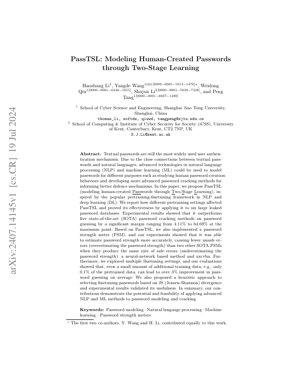
Textual passwords remain the dominant authentication mechanism, yet their human-created nature makes them vulnerable to data-driven attacks. Existing state-of-the-art (SOTA) modeling approaches, including Markov chains, pattern-based models, RNNs, and GANs, have limitations in capturing the complex, language-like yet distinct structure of passwords. Inspired by the transformative pretraining-fine-tuning paradigm in Natural Language Processing (NLP), this paper introduces PassTSL (modeling human-created Passwords through Two-Stage Learning). PassTSL leverages transformer-based architectures to first learn general password creation patterns from a large, diverse dataset (pretraining) and then specialize the model for a specific target context using a smaller, relevant dataset (fine-tuning). This approach aims to bridge the gap between advanced NLP techniques and the unique challenges of password modeling.
2. Methodology: The PassTSL Framework
The core innovation of PassTSL is its structured two-phase learning process, mirroring successful strategies in models like BERT and GPT.
2.1. Pretraining Phase
The model is initially trained on a large, general password corpus (e.g., amalgamated data from multiple breaches). The objective is to learn fundamental character-level dependencies, common substitution patterns (e.g., 'a' -> '@', 's' -> '$'), and probabilistic structures that are ubiquitous across different password sets. This phase builds a robust foundational model of human password-creation behavior.
2.2. Fine-tuning Phase
The pretrained model is then adapted to a specific target password database. Using a relatively small sample from the target set, the model's parameters are adjusted. The paper explores a heuristic for selecting fine-tuning data based on Jensen-Shannon (JS) divergence between the pretraining and target distributions, aiming to choose the most informative samples for adaptation.
2.3. Model Architecture & Technical Details
PassTSL is built upon a transformer decoder architecture, utilizing the self-attention mechanism to weigh the importance of different characters in a sequence when predicting the next character. The model treats a password as a sequence of characters (tokens). The training involves a masked language modeling (MLM) style objective during pretraining, where the model learns to predict randomly masked characters within a password sequence, capturing bidirectional context.
3. Experimental Setup & Results
3.1. Datasets and Baselines
Experiments were conducted on six large, real-world leaked password databases. PassTSL was compared against five SOTA password guessing tools, including Markov-based (e.g., PCFG), RNN-based, and GAN-based models.
3.2. Password Guessing Performance
PassTSL significantly outperformed all baselines. The improvement in guess success rate at the maximum point ranged from 4.11% to 64.69%, demonstrating the effectiveness of the two-stage approach. The results indicate that pretraining on a large corpus provides a substantial advantage over models trained from scratch on a single target set.
Performance Gain Over SOTA
Range: 4.11% - 64.69%
Context: Improvement in password guess success rate at maximum evaluation point.
3.3. Password Strength Meter (PSM) Evaluation
A PSM was implemented based on PassTSL's probability estimates. It was evaluated against a neural-network-based PSM and the rule-based zxcvbn. The key metric was the trade-off between "safe errors" (underestimating strength) and "unsafe errors" (overestimating strength). At an equal rate of safe errors, the PassTSL-based PSM produced fewer unsafe errors, meaning it was more accurate at identifying genuinely weak passwords.
3.4. Impact of Fine-tuning Data Selection
The study found that even a small amount of targeted fine-tuning data (e.g., 0.1% of the pretraining data volume) could lead to an average improvement of over 3% in guessing performance on the target set. The JS divergence-based selection heuristic was shown to be effective in choosing beneficial fine-tuning samples.
4. Key Insights & Analysis
Core Insight: The paper's fundamental breakthrough is recognizing that password creation is a specialized, constrained form of natural language generation. By treating it as such and applying the modern NLP toolkit—specifically the transformer architecture and the two-stage learning paradigm—the authors achieve a paradigm shift in modeling fidelity. This isn't just an incremental improvement; it's a methodological leap that redefines the upper bound of what's possible in probabilistic password cracking.
Logical Flow: The argument is compellingly simple: 1) Passwords share statistical and semantic properties with language. 2) The most successful modern language models use pretraining on vast corpora followed by task-specific fine-tuning. 3) Therefore, applying this framework to passwords should yield superior models. The experimental results across six diverse datasets validate this logic unequivocally, showing consistent and often dramatic gains over previous generation models like Markov chains and even earlier neural approaches like RNNs and GANs.
Strengths & Flaws: The primary strength is the demonstrated performance, which is formidable. The use of JS divergence for fine-tuning sample selection is a clever, practical heuristic. However, the analysis has flaws. It glosses over the computational and data hunger of transformer models. Pretraining requires a massive, aggregated password corpus, raising ethical and practical concerns about data sourcing. Furthermore, while it beats other models, the paper doesn't deeply explore why the transformer attention mechanism is so much better for this task than, say, an LSTM's gated memory. Is it the long-range dependency capture, or something else? This "black box" aspect remains.
Actionable Insights: For security practitioners, this research sounds an alarm. Defensive password strength meters must evolve beyond dictionary-and-rule systems (like zxcvbn) to incorporate such deep learning models to accurately assess risk. For researchers, the path forward is clear: explore more efficient architectures (e.g., distilled models), investigate federated learning for pretraining without centralizing sensitive data, and use these models not just for cracking but for generating robust password policy suggestions. The era of simple heuristic defenses is over; the arms race is now firmly in the domain of AI.
5. Technical Details & Mathematical Formulation
The transformer model in PassTSL uses a stack of $N$ identical layers. Each layer has two sub-layers: a multi-head self-attention mechanism and a position-wise fully connected feed-forward network. Residual connections and layer normalization are employed around each sub-layer.
The self-attention function maps a query ($Q$), a set of key-value pairs ($K$, $V$) to an output. The output is computed as a weighted sum of the values, where the weight assigned to each value is determined by the compatibility function of the query with the corresponding key. For a single attention head: $$\text{Attention}(Q, K, V) = \text{softmax}\left(\frac{QK^T}{\sqrt{d_k}}\right)V$$ where $d_k$ is the dimension of the keys.
The pretraining objective involves predicting masked tokens. Given an input password sequence $X = (x_1, x_2, ..., x_T)$, a random subset of tokens is replaced with a special `[MASK]` token. The model is trained to predict the original tokens for these masked positions, maximizing the log-likelihood: $$\mathcal{L}_{PT} = \sum_{i \in M} \log P(x_i | X_{\backslash M})$$ where $M$ is the set of masked positions.
Fine-tuning adjusts the model parameters $\theta$ on a target dataset $D_{ft}$ to minimize the negative log-likelihood of the sequences: $$\mathcal{L}_{FT} = -\sum_{(X) \in D_{ft}} \log P(X | \theta)$$
6. Analysis Framework: A Non-Code Case Study
Scenario: A security team at a large tech company wants to assess the resilience of employee passwords against a state-of-the-art attack.
- Data Preparation: The team legally aggregates a large, general password corpus from multiple public, anonymized breach sources (for pretraining). They also obtain a small, sanitized sample of their own company's password hashes (for fine-tuning), ensuring no plaintext passwords are exposed to the analysts.
- Model Application: They deploy a PassTSL-like framework.
- Step A (Pretraining): Train the base transformer model on the general corpus. The model learns global patterns like "password123", "qwerty", and common leetspeak substitutions.
- Step B (Fine-tuning): Using the JS divergence heuristic, select the 0.1% of the pretraining data most statistically similar to their company's password sample. Fine-tune the pretrained model on this selected subset combined with their company sample. This adapts the model to company-specific patterns (e.g., use of internal product names, specific date formats).
- Evaluation: The fine-tuned model generates a guess list. The team compares the crack rate against their existing defenses (e.g., hashcat with standard rule sets). They find PassTSL cracks 30% more passwords within the first 10^9 guesses, revealing a significant vulnerability that traditional methods missed.
- Action: Based on the model's output, they identify the most frequently guessed patterns and implement a targeted password policy change (e.g., banning passwords that contain the company name) and launch a focused user education campaign.
7. Future Applications & Research Directions
- Proactive Defense & Password Hygiene: PassTSL models can be integrated into real-time password creation interfaces as ultra-accurate strength meters, preventing users from choosing passwords that the model can easily guess. This moves beyond static rules to dynamic, probabilistic rejection.
- Adversarial Password Generation: Inverse the model to generate passwords that are maximally improbable according to the learned distribution, suggesting truly strong passwords to users, similar to how generative models like CycleGAN learn to translate between domains.
- Federated & Privacy-Preserving Learning: Future work must address the data privacy challenge. Techniques like federated learning, where the model is trained across decentralized data sources without exchanging raw passwords, or using differential privacy during training, are critical for ethical adoption.
- Cross-Modal Password Analysis: Extend the framework to model passwords associated with other user data (e.g., usernames, security questions) to build more comprehensive user profiling models for targeted attacks or, conversely, for multi-factor risk assessment.
- Efficiency Optimization: Research into model distillation, quantization, and more efficient attention mechanisms (e.g., Linformer, Performer) to make these powerful models deployable on edge devices or in low-latency web applications.
8. References
- Vaswani, A., et al. (2017). Attention Is All You Need. Advances in Neural Information Processing Systems 30 (NIPS 2017).
- Weir, M., et al. (2009). Password Cracking Using Probabilistic Context-Free Grammars. IEEE Symposium on Security and Privacy.
- Melicher, W., et al. (2016). Fast, Lean, and Accurate: Modeling Password Guessability Using Neural Networks. USENIX Security Symposium.
- Hitaj, B., et al. (2019). PassGAN: A Deep Learning Approach for Password Guessing. Applied Intelligence.
- Wheeler, D. L. (2016). zxcvbn: Low-Budget Password Strength Estimation. USENIX Security Symposium.
- Devlin, J., et al. (2018). BERT: Pre-training of Deep Bidirectional Transformers for Language Understanding. arXiv preprint arXiv:1810.04805.
- Zhu, J.Y., et al. (2017). Unpaired Image-to-Image Translation using Cycle-Consistent Adversarial Networks. IEEE International Conference on Computer Vision (ICCV). (CycleGAN reference for generative concept).
- National Institute of Standards and Technology (NIST). (2017). Digital Identity Guidelines (SP 800-63B). (For authoritative context on authentication).