1. Introduction
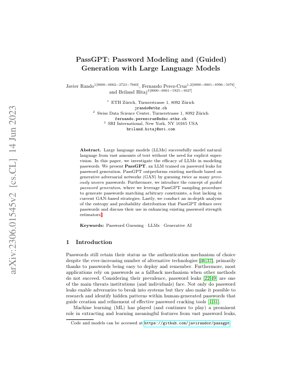
Despite advancements in authentication technologies, passwords remain the dominant mechanism due to their simplicity and deployability. Password leaks pose significant security threats, enabling both unauthorized access and the refinement of cracking tools. This paper investigates the application of Large Language Models (LLMs) to password modeling, introducing PassGPT—a model trained on password leaks for generation and strength estimation.
The research demonstrates that PassGPT outperforms existing Generative Adversarial Network (GAN)-based methods by guessing 20% more previously unseen passwords and introduces guided password generation—a novel capability for generating passwords under arbitrary constraints.
2. Methodology & Architecture
PassGPT is built upon the GPT-2 architecture, adapted for the sequential generation of password characters. This approach contrasts with GANs that generate passwords as complete units.
2.1. PassGPT Model Design
The model is an autoregressive Transformer trained on large-scale password leaks. It learns the probability distribution $P(x_t | x_{
2.2. Guided Password Generation
A key innovation is character-level guided generation. By manipulating the sampling procedure (e.g., using conditional probabilities or masking), PassGPT can generate passwords that satisfy specific constraints, such as containing certain symbols, meeting length requirements, or including specific substrings—a feat not achievable with standard GANs.
2.3. PassVQT Enhancement
PassVQT incorporates Vector Quantized Transformer (VQT) techniques, using a discrete codebook to represent latent embeddings. This can increase the perplexity and diversity of generated passwords, though it may come at a computational cost.
3. Experimental Results
3.1. Password Guessing Performance
Experiments on real-world password leaks (e.g., RockYou) show PassGPT significantly outperforms prior state-of-the-art deep generative models like PassGAN. In one test, PassGPT guessed twice as many unique, previously unseen passwords compared to GAN-based approaches. It also demonstrated strong generalization to novel, held-out datasets.
Performance Comparison
PassGPT vs. GANs: 20% higher success rate in guessing unseen passwords.
Generalization: Effective performance on novel password leaks not seen during training.
3.2. Probability Distribution Analysis
Unlike GANs, PassGPT provides an explicit probability distribution over passwords. Analysis shows a strong correlation between low password probability (high negative log-likelihood) and high strength as measured by estimators like zxcvbn. However, PassGPT identified instances where passwords deemed "strong" by conventional estimators had relatively high probability under its model, indicating potential vulnerabilities.
Chart Implication: A hypothetical scatter plot would show password probability (PassGPT) on the x-axis and strength score (zxcvbn) on the y-axis, revealing a general negative trend with notable outliers where high-strength passwords have unexpectedly high probability.
4. Technical Analysis & Framework
Industry Analyst Perspective: A critical evaluation of the PassGPT approach, its implications, and practical takeaways.
4.1. Core Insight
The paper's fundamental breakthrough isn't just another AI model for passwords; it's a paradigm shift from discriminative pattern matching to generative sequence modeling. While tools like Hashcat rely on rules and Markov chains, and GANs like PassGAN generate holistic outputs, PassGPT treats password creation as a linguistic act. This mirrors how LLMs like GPT-3 capture the "grammar" and "semantics" of natural language, but here applied to the "language" of human password creation. The real value proposition is the explicit, tractable probability distribution it provides—a feature conspicuously absent in GANs, which are often criticized as "black boxes" (Goodfellow et al., 2014). This moves password security from heuristic guesswork to probabilistic reasoning.
4.2. Logical Flow
The argument proceeds with compelling logic: (1) LLMs dominate NLP by modeling sequences; (2) passwords are sequences of characters with latent structure; (3) therefore, LLMs should effectively model passwords. The validation is robust: superior guessing performance proves the premise. The introduction of guided generation is a natural extension of the sequential architecture—akin to controlled text generation in models like CTRL (Keskar et al., 2019). The analysis of the probability distribution is the critical next step, bridging generative modeling back to the practical domain of strength estimation. The flow from modeling -> generation -> analysis -> application is coherent and impactful.
4.3. Strengths & Flaws
Strengths: The performance gains are undeniable. The guided generation capability is a genuine innovation with immediate applications for penetration testing (generating rule-compliant password candidates) and possibly for helping users create memorable yet complex passwords. Providing a probability distribution is a major theoretical and practical advantage, enabling entropy calculation and integration with existing security frameworks.
Flaws & Concerns: The paper glosses over significant issues. First, ethical dual-use: This is a powerful cracking tool. While positioned for "offline guessing" research, its potential for misuse is high, and the release of code/models requires stringent ethical guidelines, akin to debates surrounding other dual-use AI research (Brundage et al., 2018). Second, data dependency: Like all ML models, PassGPT is only as good as its training data. It may fail to model passwords from cultures or languages underrepresented in common leaks. Third, computational cost: Training and running large transformers is resource-intensive compared to some older methods, potentially limiting real-time application. The PassVQT variant's increased "perplexity" is mentioned but not thoroughly evaluated—does higher diversity translate to more effective guessing, or just more nonsense strings?
4.4. Actionable Insights
For Security Teams: Immediately assess how your organization's password policies might be vulnerable to this new generation of AI-driven attacks. Policies mandating complex but predictable patterns (e.g., "CompanyName2024!") are now more exposed. Advocate for a shift towards using true randomness (password managers) or passphrases.
For Researchers & Vendors: Integrate LLM-based probability estimates into strength meters. A hybrid estimator combining traditional rules (zxcvbn) with PassGPT's likelihood could be more robust. Develop defensive models that can detect passwords likely to be generated by PassGPT, creating an AI vs. AI arms race in password security.
For Policy Makers: Fund research into defensive applications of this technology and establish clear ethical frameworks for the publication of powerful offensive AI tools in cybersecurity.
Framework Example (Non-Code): Consider a financial institution's password policy: "12 chars, 1 upper, 1 lower, 1 number, 1 special char." A traditional cracking tool might brute-force or use mangling rules. A GAN might struggle to generate outputs that strictly meet all constraints. PassGPT's guided generation can be directed to sample only sequences fulfilling this exact policy, efficiently exploring the high-probability subspace of that constrained search space, making it a potent tool for both red teams testing this policy and for black-box attackers.
5. Future Applications & Directions
- Enhanced Strength Estimation: Integration of PassGPT's probability scores into real-time password strength meters for websites and applications.
- Proactive Password Auditing: Organizations can use guided PassGPT models to proactively generate and test passwords that comply with internal policies, identifying weak spots before attackers do.
- Hybrid Defense Models: Developing discriminative models that can distinguish between human-chosen and LLM-generated passwords to flag potentially compromised or weak credentials.
- Cross-Domain Sequence Modeling: Applying the same architecture to other security-relevant sequences, such as network protocol fingerprints, malware API call sequences, or fraudulent transaction patterns.
- Federated & Privacy-Preserving Training: Exploring techniques to train such models on distributed, anonymized password data without centralizing sensitive leaks.
- Adversarial Password Generation: Using the guided generation to create "adversarial examples"—passwords that appear strong to estimators but are easily guessed by the model—to stress-test and improve those estimators.
6. References
- Rando, J., Perez-Cruz, F., & Hitaj, B. (2023). PassGPT: Password Modeling and (Guided) Generation with Large Language Models. arXiv preprint arXiv:2306.01545.
- Goodfellow, I., Pouget-Abadie, J., Mirza, M., Xu, B., Warde-Farley, D., Ozair, S., ... & Bengio, Y. (2014). Generative adversarial nets. Advances in neural information processing systems, 27.
- Radford, A., Wu, J., Child, R., Luan, D., Amodei, D., & Sutskever, I. (2019). Language models are unsupervised multitask learners. OpenAI blog, 1(8), 9.
- Hitaj, B., Gasti, P., Ateniese, G., & Perez-Cruz, F. (2019). PassGAN: A Deep Learning Approach for Password Guessing. In Applied Cryptography and Network Security.
- Keskar, N. S., McCann, B., Varshney, L. R., Xiong, C., & Socher, R. (2019). Ctrl: A conditional transformer language model for controllable generation. arXiv preprint arXiv:1909.05858.
- Brundage, M., Avin, S., Clark, J., Toner, H., Eckersley, P., Garfinkel, B., ... & Amodei, D. (2018). The malicious use of artificial intelligence: Forecasting, prevention, and mitigation. arXiv preprint arXiv:1802.07228.
- Wheeler, D. L. (2016). zxcvbn: Low-budget password strength estimation. In USENIX Security Symposium.