Table of Contents
1. Introduction
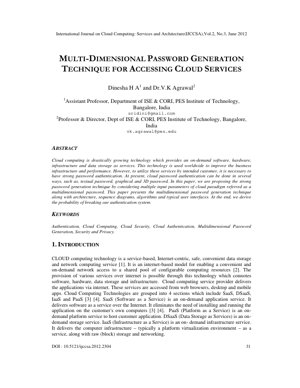
Cloud computing has emerged as a transformative, service-based technology providing on-demand access to software, hardware, infrastructure, and data storage over the internet. Its adoption aims to improve business infrastructure and performance. However, secure access to these services is paramount, relying heavily on robust authentication mechanisms.
Current cloud authentication methods include textual passwords, graphical passwords, and 3D passwords, each with significant drawbacks. Textual passwords are vulnerable to dictionary and brute-force attacks. Graphical passwords, while leveraging visual memory, often suffer from smaller password spaces or high time complexity. 3D passwords also present specific limitations.
This paper proposes a Multi-Dimensional Password Generation Technique to address these weaknesses. The core idea is to generate a strong password by combining multiple input parameters from the cloud paradigm, such as logos, images, textual information, and signatures. This approach aims to drastically increase the password space and complexity, thereby reducing the probability of successful brute-force attacks.
2. Proposed Multi-Dimensional Password Generation Technique
The proposed technique authenticates cloud access using a password constructed from multiple dimensions or parameters. This moves beyond single-factor (text) or dual-factor approaches to a more holistic, context-aware authentication model.
2.1 Architecture and Components
The system architecture involves a client-side interface for parameter input and a server-side engine for password generation and verification. Key components include:
- Parameter Input Module: Collects diverse inputs from the user (e.g., selected service logo, a personal image snippet, a text phrase, a graphical signature).
- Fusion Engine: Algorithmically combines the input parameters into a unique, high-entropy token.
- Authentication Server: Stores the generated multi-dimensional hash and validates user login attempts.
- Cloud Service Gateway: Grants access upon successful authentication.
2.2 Sequence Diagram and Workflow
The authentication sequence follows these steps:
- User accesses the cloud portal and initiates login.
- The system presents the multi-dimensional input interface.
- User provides the required parameters (e.g., selects SaaS icon, draws a pattern, enters a keyword).
- The client-side module sends the parameter set to the authentication server.
- The server's fusion engine processes the inputs, generates a hash, and compares it with the stored credential.
- If matched, access is granted to the requested cloud service (SaaS, IaaS, PaaS, DSaaS).
2.3 Algorithm for Password Generation
The paper outlines a conceptual algorithm where the final password $P_{md}$ is a function $F$ of $n$ input parameters: $P_{md} = F(p_1, p_2, p_3, ..., p_n)$. Each parameter $p_i$ belongs to a different dimension (visual, textual, symbolic). The function $F$ likely involves concatenation, hashing (e.g., SHA-256), and possibly salting to produce a fixed-length cryptographic token.
3. Detailed Design and Implementation
3.1 User Interface Design
The proposed user interface is a multi-panel web form. A typical interface might include:
- A grid of cloud service logos (SaaS, IaaS, PaaS, DSaaS) for selection.
- A canvas for drawing a simple signature or shape.
- A text field for entering a passphrase.
- An image upload area for a personal photo (with a crop tool for selecting a specific region).
The combination is unique to the user's session and cloud service context.
3.2 Security Probability Analysis
A key contribution is the theoretical analysis of the attack probability. If a traditional text password has a space size $S_t$, and each added dimension $i$ has a space size $S_i$, the total password space for the multi-dimensional scheme becomes $S_{total} = S_t \times S_1 \times S_2 \times ... \times S_n$.
The probability of a successful brute-force attack is inversely proportional to $S_{total}$: $P_{attack} \approx \frac{1}{S_{total}}$. By making $S_{total}$ astronomically large (e.g., $10^{20}$+), the proposed technique aims to reduce $P_{attack}$ to a negligible level, even against distributed computing attacks feasible in cloud environments.
4. Conclusion and Future Work
The paper concludes that the Multi-Dimensional Password Generation technique offers a stronger alternative to existing cloud authentication methods by leveraging the multi-faceted nature of the cloud paradigm itself. It significantly expands the password space, making brute-force attacks computationally infeasible.
Future work includes implementing a full prototype, conducting user studies to assess memorability and usability, integrating with standard cloud APIs (like OAuth 2.0/OpenID Connect), and exploring the use of machine learning to detect anomalous input patterns during authentication.
5. Original Analysis & Expert Insight
Core Insight: This 2012 paper identifies a critical, enduring flaw in cloud security—the reliance on weak, single-dimensional authentication—and proposes a combinatorial solution. Its foresight is commendable, as today's attacks increasingly leverage cloud compute power for credential stuffing. The core idea of "contextual entropy"—deriving password strength from the service ecosystem itself—is more relevant now than ever, anticipating principles later seen in adaptive authentication.
Logical Flow: The argument is solid: 1) Cloud adoption is booming. 2) Current passwords are broken. 3) Therefore, we need a paradigm shift. The proposed shift is logical: fight cloud-scale attacks with cloud-contextual secrets. However, the flow stumbles by not rigorously comparing the proposed technique's complexity to emerging standards from that era, like FIDO's early concepts, which were also gaining traction for solving similar problems.
Strengths & Flaws: The major strength is the theoretical security gain. By multiplying independent probabilities, the scheme creates a formidable barrier. This aligns with principles in cryptography, where key space is paramount. The paper's weakness is its glaring omission of usability. It treats password creation as a purely cryptographic problem, ignoring the human factor—the Achilles' heel of most security systems. Studies by organizations like NIST and the SANS Institute consistently show that overly complex authentication leads to user workarounds (like writing passwords down), negating any security benefit. Furthermore, the paper lacks a concrete discussion on how to securely transmit and hash these diverse data types, a non-trivial engineering challenge.
Actionable Insights: For modern practitioners, this paper is a thought-starter, not a blueprint. The actionable insight is to embrace its philosophy of layered, context-aware authentication but implement it using modern, user-centric tools. Instead of building a custom multi-input UI, integrate a proven multi-factor authentication (MFA) provider. Use risk-based authentication (RBA) that considers context (device, location, time) silently in the background. For high-value access, combine this with hardware security keys (FIDO2/WebAuthn), which provide phishing-resistant strong authentication without burdening the user with memorizing complex multi-dimensional inputs. The future isn't in making passwords more complex for humans to create, but in making authentication more seamless and robust through technology that operates transparently.
6. Technical Details & Mathematical Formulation
The security of the scheme can be modeled mathematically. Let:
- $D = \{d_1, d_2, ..., d_n\}$ be the set of dimensions (e.g., $d_1$=Logo, $d_2$=Image, $d_3$=Text).
- $V_i$ be the set of possible values for dimension $d_i$, with size $|V_i|$.
- The total password space size is: $N = \prod_{i=1}^{n} |V_i|$.
Assuming an attacker can make $G$ guesses per second, the expected time $T$ to break the password is: $T \approx \frac{N}{2G}$ seconds. For example, if $|V_{logo}|=10$, $|V_{image}|=100$ (considering selectable regions), $|V_{text}|=10^6$ (for a 6-character text password), then $N = 10 \times 100 \times 10^6 = 10^9$. If $G=10^9$ guesses/sec (aggressive cloud-based attack), $T \approx 0.5$ seconds, which is weak. This shows the critical need for high-entropy inputs in each dimension. The paper suggests using more dimensions or richer inputs (e.g., $|V_{image}|=10^6$) to push $N$ to $10^{20}$ or higher, making $T$ impractically large.
7. Experimental Results & Chart Description
While the paper is primarily conceptual, it implies a comparative analysis of attack probability. A derived chart would likely plot Password Space Size (log scale) against Estimated Time to Crack for different schemes.
- Line 1 (Text Password): Shows a low plateau. Even with $10^{10}$ possibilities, it's crackable in minutes/hours with cloud computing.
- Line 2 (Graphical Password): Shows a moderate increase, but often limited by practical grid sizes (e.g., 10x10 grid for click-points).
- Line 3 (Proposed Multi-Dim): Shows a steep, exponential climb. As dimensions (n) increase from 2 to 4, the password space jumps several orders of magnitude (e.g., from $10^{12}$ to $10^{24}$), pushing the estimated crack time from days to billions of years, even under extreme attack scenarios.
This theoretical chart visually demonstrates the core security proposition: multiplicative complexity leads to exponential security gains.
8. Analysis Framework: Example Case
Scenario: A financial services company "FinCloud" uses a SaaS application for portfolio management. They are concerned about credential-based attacks.
Applying the Framework:
- Dimension Mapping: For FinCloud's login, we define 3 dimensions:
- $D_1$: Service Context (User must select the specific portfolio management app icon from a set of 5 company-approved SaaS icons).
- $D_2$: Knowledge Factor (User enters a 4-digit PIN: $10^4$ possibilities).
- $D_3$: Inherence Factor (Simplified) (User selects one of 4 pre-registered graphical tokens, like a specific stock chart pattern). - Space Calculation: Total password space $N = 5 \times 10^4 \times 4 = 200,000$. This is still low.
- Security Assessment: Pure implementation is weak. Enhanced Modern Implementation: Replace $D_2$ with a time-based one-time password (TOTP from an app, $10^6$ space). Replace $D_3$ with a behavioral biometric (typing rhythm analyzed silently). Now, $N$ becomes effectively the product of TOTP space and biometric false acceptance rate, creating a robust, multi-factor, context-aware system that is user-friendly.
This case shows how the paper's multi-dimensional concept can be evolved into a practical, modern authentication strategy.
9. Future Applications & Directions
The principles of multi-dimensional authentication extend beyond traditional cloud login:
- IoT Device Onboarding: Authenticating a new smart device to a cloud platform could require a combination of a QR code scan (visual dimension), a device-generated nonce (data dimension), and a physical button press (action dimension).
- Privileged Access Management (PAM): Access to cloud admin consoles could require a password, a certificate (machine identity dimension), and a geo-fencing check (location dimension).
- Decentralized Identity (Self-Sovereign Identity): Multi-dimensional credentials could be represented as verifiable claims in a blockchain-based identity wallet, where authentication involves proving possession of multiple claims (e.g., a credential from employer, a government ID, a university degree) without revealing the raw data.
- AI-Powered Adaptive Dimensions: Future systems could use AI to dynamically select which dimensions to challenge based on real-time risk score. A low-risk login from a known device might only require one dimension, while a high-risk attempt triggers multiple, including out-of-band verification.
The evolution lies in making these dimensions more seamless, standardized, and privacy-preserving.
10. References
- Mell, P., & Grance, T. (2011). The NIST Definition of Cloud Computing. National Institute of Standards and Technology, SP 800-145.
- Buyya, R., Yeo, C. S., Venugopal, S., Broberg, J., & Brandic, I. (2009). Cloud computing and emerging IT platforms: Vision, hype, and reality for delivering computing as the 5th utility. Future Generation computer systems, 25(6), 599-616.
- SANS Institute. (2020). The Human Element in Security: Behavioral Psychology and Secure Design. InfoSec Reading Room.
- FIDO Alliance. (2022). FIDO2: WebAuthn & CTAP Specifications. https://fidoalliance.org/fido2/
- Bonneau, J., Herley, C., van Oorschot, P. C., & Stajano, F. (2012). The quest to replace passwords: A framework for comparative evaluation of web authentication schemes. In 2012 IEEE Symposium on Security and Privacy (pp. 553-567). IEEE.
- OWASP Foundation. (2021). OWASP Authentication Cheat Sheet. https://cheatsheetseries.owasp.org/cheatsheets/Authentication_Cheat_Sheet.html