1. Introduction & Overview
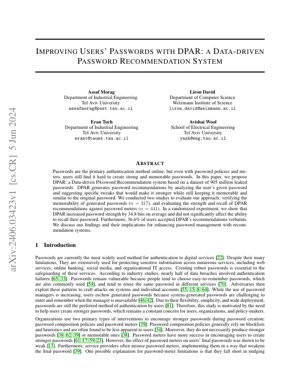
Passwords remain the dominant form of online authentication despite well-known vulnerabilities stemming from user behavior—choosing weak, predictable, and reused passwords. Traditional interventions like password composition policies and meters have shown limited effectiveness in creating a lasting improvement in password strength without harming memorability. This paper introduces DPAR (Data-driven PAssword Recommendation system), a novel approach that bridges this gap. Instead of generating random strings or providing vague feedback, DPAR analyzes a user's initially chosen password and suggests specific, minimal tweaks to strengthen it, leveraging patterns learned from a massive dataset of 905 million real-world leaked passwords. The core hypothesis is that personalized, incremental suggestions are more likely to be adopted and remembered than wholesale replacements.
2. The DPAR System
DPAR represents a paradigm shift from passive feedback to active, data-informed guidance.
2.1 Core Methodology & Data Foundation
The system's intelligence is derived from the "Qwerty and 123" dataset containing 905 million leaked passwords. By analyzing this corpus, DPAR builds a probabilistic model of common password structures, weak patterns (like "1qaz1qaz"), and substitution habits. This allows it to identify the specific elements in a user's password that are most vulnerable to dictionary or pattern-based attacks and suggest targeted improvements. The foundational principle mirrors techniques in adversarial machine learning, where a model is trained on real-world data (like CycleGAN's use of unpaired image sets) to learn transformation rules that preserve core attributes (memorability) while altering others (strength).
2.2 Recommendation Algorithm & User Flow
The user experience is iterative and consultative. A user inputs a password. DPAR evaluates it and may propose a specific change, such as substituting a character (e.g., 'a' -> '@'), adding a suffix, or capitalizing a specific letter. The suggestion is presented as a minor edit to the user's original idea, not a foreign string. For example, for the weak password "1qaz1qaz", DPAR might suggest "1q@z1qaz!", adding a symbol and an exclamation mark. This process can repeat until a satisfactory strength threshold is met, balancing security and user acceptance.
3. Experimental Evaluation
The paper validates DPAR through two robust user studies.
3.1 Study 1: Memorability Verification (n=317)
This study tested whether passwords modified by DPAR's rules remained memorable. Participants created a password, received a DPAR-modified version, and were later tested on recall. Results indicated no statistically significant decrease in recall rates compared to the original passwords, confirming that the "minimal tweak" philosophy successfully preserves memorability.
3.2 Study 2: Strength & Recall vs. Password Meters (n=441)
This randomized controlled trial compared DPAR against traditional password meters. Participants were assigned to either a group using a standard meter or a group receiving DPAR recommendations during password creation.
3.3 Key Results & Statistical Summary
+34.8 bits
Average increase in password strength (entropy) for the DPAR group.
36.6%
Verbatim acceptance rate of DPAR's first recommendation.
No Significant Impact
On users' ability to recall their DPAR-modified passwords.
The DPAR group achieved substantially stronger final passwords without compromising recall, outperforming the meter-only group. The high verbatim acceptance rate is a critical metric, indicating strong user compliance with the guided approach.
4. Technical Deep Dive
4.1 Mathematical Foundation & Strength Calculation
Password strength is quantified using entropy, measured in bits. The entropy $H$ of a password is calculated based on the size of the character set $N$ and the length $L$, approximated as $H = L \cdot \log_2(N)$. However, this assumes random selection. DPAR's model must discount for predictable patterns. A more nuanced model, akin to a Markov chain or a probabilistic context-free grammar trained on the leak dataset, estimates the actual entropy $H_{actual}$ by considering the likelihood of the sequence: $H_{actual} \approx -\log_2(P(password))$, where $P(password)$ is the probability of that password structure occurring in the training corpus. DPAR's goal is to suggest the minimal change that maximizes the increase in $H_{actual}$.
4.2 Analysis Framework: The DPAR Evaluation Matrix
Scenario: Evaluating the password "summer2024".
DPAR Analysis:
- Pattern Detection: Identifies as a common dictionary word ("summer") followed by a recent year.
- Vulnerability Assessment: Highly susceptible to dictionary and hybrid attacks. Very low $H_{actual}$.
- Recommendation Generation (Examples):
- Substitution: "$ummer2024" (replace 's' with '$').
- Infix Addition: "summer!2024" (add '!').
- Controlled Capitalization: "sUmmer2024" (capitalize 'U').
- Strength Re-evaluation: Each suggestion is scored for its estimated entropy gain and memorability impact. "$ummer2024" might be prioritized for its significant strength boost with minimal cognitive load.
This framework demonstrates how DPAR moves from diagnosis to targeted prescription.
5. Critical Analysis & Industry Perspective
Core Insight: DPAR isn't just another password meter; it's a behavioral intervention engine. Its genius lies in reframing the security problem from "user education" to "user collaboration." By making microscopic, data-justified edits to a user's own mental model, it bypasses the psychological resistance to system-generated gibberish. The 36.6% verbatim acceptance rate isn't just a number—it's a testament to a superior user experience design in a domain plagued by friction.
Logical Flow: The research logic is impeccable. It starts with the well-documented failure of existing tools (policies, meters), posits that specificity and personalization are missing, builds a system (DPAR) to test that hypothesis using the largest available real-world dataset, and validates it with controlled experiments measuring both security (bits) and usability (recall, acceptance). This is how applied cybersecurity research should be done.
Strengths & Flaws: The primary strength is its pragmatic, human-centric approach, backed by robust data and clear results. However, a critical flaw lies in its potential attack surface. If the recommendation algorithm becomes predictable, attackers could reverse-engineer it to refine their guessing strategies—a classic arms race seen in adversarial AI, as discussed in papers like "Adversarial Machine Learning at Scale" (Goodfellow et al., ICLR 2015). Furthermore, its dependence on a static leak corpus may not adapt quickly to new cultural trends or targeted social engineering patterns.
Actionable Insights: For CISOs and product managers, the takeaway is clear: Stop relying on red/yellow/green bars. Integrate context-aware, suggestive systems like DPAR into your registration and password change flows immediately. The ROI in reduced account takeover risk is evident. For researchers, the next step is to harden DPAR against adversarial analysis and explore federated learning techniques to update its model without centralizing new password data, thus addressing privacy concerns highlighted by institutions like the National Institute of Standards and Technology (NIST) in their Digital Identity Guidelines.
6. Future Applications & Research Directions
- Proactive Password Checkup: Integration into password managers to periodically suggest strengthening tweaks for stored passwords, moving beyond mere breach alerts.
- Adaptive & Context-Aware Systems: DPAR models that consider the specific value of the account (e.g., banking vs. forum), suggesting more aggressive changes for high-value targets.
- Phishing Resistance Training: Using the recommendation engine to teach users about weak patterns by interactively showing how their hypothetical passwords would be strengthened.
- Integration with Biometric Fallback: In multi-factor authentication schemes, DPAR-modified passwords could serve as a more robust fallback when biometrics fail.
- Privacy-Preserving Model Training: Exploring techniques like differential privacy or on-device learning to improve the model's dataset without compromising new user passwords.
7. References
- Morag, A., David, L., Toch, E., & Wool, A. (2024). Improving Users' Passwords with DPAR: A Data-Driven Password Recommendation System. arXiv preprint arXiv:2406.03423.
- Goodfellow, I., Shlens, J., & Szegedy, C. (2015). Explaining and harnessing adversarial examples. International Conference on Learning Representations (ICLR).
- National Institute of Standards and Technology (NIST). (2017). Digital Identity Guidelines (SP 800-63B).
- Ur, B., et al. (2016). Design and evaluation of a data-driven password meter. Proceedings of the CHI Conference on Human Factors in Computing Systems.
- Zhu, J.-Y., Park, T., Isola, P., & Efros, A. A. (2017). Unpaired image-to-image translation using cycle-consistent adversarial networks. Proceedings of the IEEE International Conference on Computer Vision.
- Weir, M., Aggarwal, S., Medeiros, B. D. P., & Glodek, B. (2009). Password cracking using probabilistic context-free grammars. IEEE Symposium on Security and Privacy.